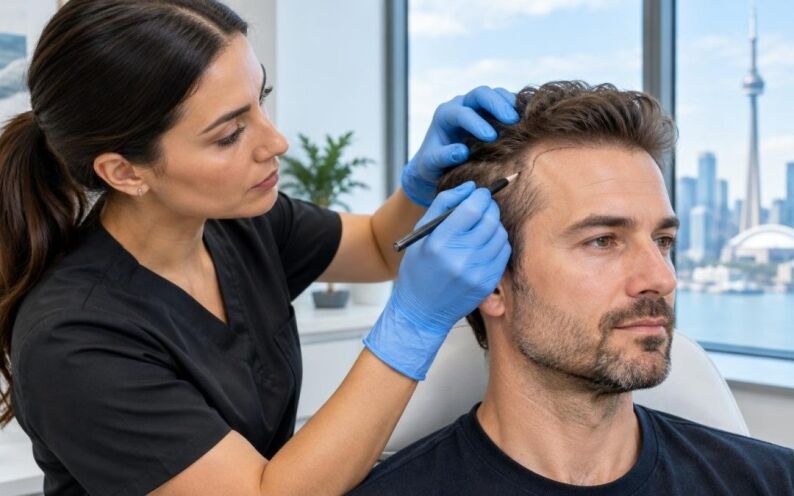
Temple recession can change the way your whole hairline reads. Even when the central hairline remains fairly strong, thinning at the temples may make the forehead seem wider or the hairline appear higher. Restoring density in this small area can help create a smoother connection between the frontal hairline, temples, and hair along the sides of the face.
At our Yorkville clinic, we approach temple restoration as a highly individual part of hair restoration planning. Follicular unit excision (FUE) in Toronto may be considered when the goal is subtle, natural-looking density that respects your facial proportions, current hair pattern, and future needs.
Why Temple Density Can Restore Facial Balance
The temples sit at an important meeting point between the forehead, frontal hairline, and side profile. When hair recedes here, the hairline can look less connected, even if there is still good coverage elsewhere. For some people, restoring this transition creates a softer frame around the face.
Temple work is different from filling a broad thinning area on the scalp. Hair in this region often lies flatter against the skin, grows at a gentle angle, and changes direction as it moves toward the sideburns. A temple point that is too sharp, dense, or straight may not blend well with the surrounding hair.
Natural-looking planning considers several details, including the following:
- Your facial shape and existing hairline
- The direction and texture of nearby hair
- Whether hair loss appears stable or may continue
- The amount and quality of available donor hair
No two temple restorations should look alike. We look at where your natural temple structure begins, how much existing hair remains, and what level of density can blend appropriately over time.
How FUE in Toronto Rebuilds Temple Density
Follicular unit extraction, often called FUE, is a hair restoration technique that involves individually harvesting follicular units from a donor area. The donor follicles are commonly taken from the back or sides of the scalp, then placed into areas of thinning based on a personalized treatment plan.
For temple restoration, individual graft placement can offer control around existing hairs. This matters because temples often need a gradual transition rather than a sudden wall of density. Finer grafts may be selected for the most visible edges, while placement farther behind the temple point can support the appearance of fuller coverage.
Before recommending FUE in Toronto, we assess the donor area closely. A thoughtful assessment includes factors such as:
- hair calibre, texture, and natural curl pattern
- donor hair density and scalp characteristics
- your current areas of thinning
- the likely long-term availability of donor follicles
Donor hair is a limited resource, so temple work should fit within the larger picture of your hair restoration goals. Planning only for what looks good today may not account for how your hair pattern could change later.
A Natural Temple Design Blends with Existing Hair
A successful temple design is usually age-appropriate and understated. Rather than creating a low, straight hairline that may not suit the face or future hair pattern, we aim for a design that works with your existing hair. The goal is often to create a believable transition, not to make the hairline look overly perfect.
Graft selection plays a large role in the final appearance. Single-hair follicular units can help create a softer leading edge and temple point. Grafts containing more than one hair may be better suited farther behind the hairline, where added density can support the overall blend.
Placement is equally important. Temple hairs may angle forward, sweep backward, or follow a flatter path than hairs at the centre of the hairline. During planning, we consider:
- the angle at which hairs leave the scalp
- the direction each graft should follow
- spacing between grafts
- slight irregularity that helps avoid an artificial outline
Small details can have a noticeable effect in such a visible area. The temple should appear connected to your existing hair, not placed on top of it.
The Right Candidates May Benefit from FUE in Toronto
People seek temple restoration for many different reasons. You may have naturally high temples, early recession, uneven temple points, or thinning that makes the forehead seem broader. Both men and women may explore a personal assessment when temple density affects how they feel about their hairline.
Hair loss should be evaluated before surgery is considered. Some people have a pattern that appears stable, while others may be noticing ongoing shedding or progressive thinning. Certain scalp concerns or medical factors may also need further review before a surgical approach makes sense.
During a consultation for FUE in Toronto, we discuss your medical history, current medications, hair goals, and the type of density that may be realistic for you. We also look at whether non-surgical options may be appropriate on their own or alongside a transplant plan. This discussion helps make sure temple restoration fits your overall hair goals instead of treating one small area in isolation.
Plan Your Personal Temple Restoration Consultation
Online hairline photos and generic templates can be useful for inspiration, but they cannot account for your face, hair texture, donor supply, or long-term pattern of thinning. A personal assessment gives us the chance to study how your temples relate to the rest of your hairline and discuss a plan that makes sense for you.
Temple restoration is often about restraint. With a thoughtful FUE plan, carefully placed follicles can gradually produce hair that grows and blends with existing hair, helping the temples look more connected without drawing attention to the treatment itself.
Personalized Planning for Natural Temple Density
At Dr. Cory Torgerson, we assess your hair characteristics, facial balance, and goals to determine whether FUE in Toronto is appropriate for your concerns. Our team can explain the procedure, expected timeline, and the considerations involved in designing a refined temple hairline. Contact us to arrange a consultation and discuss your options.