
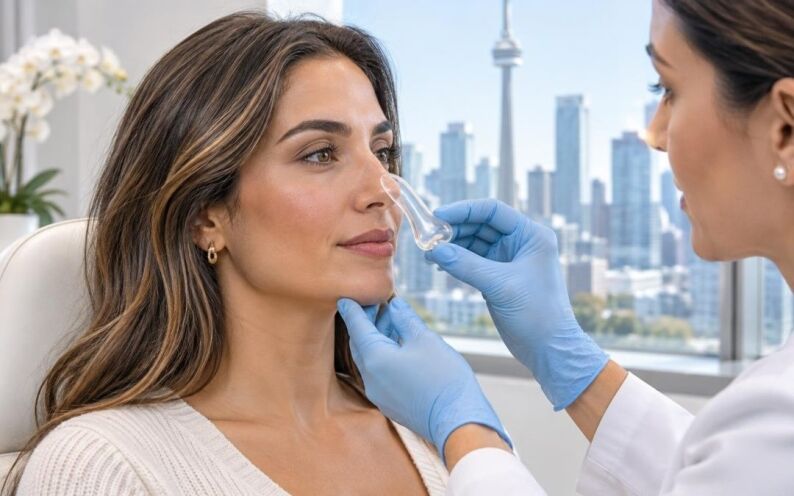
A More Defined Tip Starts with Lasting Support
A nasal tip that looks wide, rounded, or soft can make the whole nose feel less defined. For many people, the goal is not to create a tiny or overly sharp tip, but to bring better balance and shape to the nose while keeping the result natural-looking.
When we plan bulbous tip rhinoplasty in Toronto, we look beyond tip width alone. Facial proportions, skin thickness, cartilage strength, nasal breathing, and healing characteristics all matter. Lasting refinement often depends on preserving or improving the cartilage framework that supports the tip as swelling settles.
Why a Bulbous Tip Needs More than Cartilage Removal
A rounded nasal tip can develop for several anatomical reasons. The lower lateral cartilages may be broad or curved, the distance between the tip domes may be wide, or the skin over the tip may be thick. Often, more than one factor is involved.
Before making changes, we assess the framework beneath the skin. Thick skin can soften the definition that is visible early in healing, while weak cartilage may allow the tip to spread or droop over time. This helps us decide whether reshaping, repositioning, suturing, or added support may be appropriate.
Older approaches to rhinoplasty sometimes focused heavily on removing cartilage to make a broad tip smaller. Some reduction may be useful in selected cases, but taking away too much cartilage can weaken the nose. Less cartilage does not always create a better-defined tip.
Overly aggressive removal may contribute to concerns such as:
- a pinched or overly narrow appearance
- uneven nostrils or tip asymmetry
- weakness in the nasal sidewalls
- reduced tip support over time
- an appearance that looks overly operated
Instead of relying on reduction alone, we aim for a balance between refinement and reinforcement. A stable framework can help the nose remain proportionate from the front, side, and 3/4 views while also considering normal airflow. Every nose heals differently, so the final result develops gradually.
How We Build More Controlled Tip Definition
Specialized sutures can be a valuable part of tip refinement. These sutures gently bring the tip cartilages into a more balanced position, which may narrow the space between the domes and improve symmetry. They allow us to make precise changes without depending entirely on cartilage removal.
Suturing can be especially helpful when there is enough cartilage present but its shape, position, or projection needs adjustment. By preserving more of the natural framework, we can often create a smoother and more controlled contour.
Cartilage reshaping may also be part of the plan. If excess width is contributing to a bulbous appearance, we may carefully reduce or reshape selected areas of cartilage. The amount of change should reflect your skin thickness, cartilage strength, overall nose shape, and personal goals.
For some patients, added cartilage support is needed. Cartilage grafts can help when the natural tip cartilages are weak, uneven, or unlikely to hold the planned shape during healing. When grafting is appropriate, cartilage may come from the patient’s own septum or another suitable donor site.
A structural plan may include one or more of the following:
- Sutures to improve tip shape and symmetry
- Conservative cartilage reshaping for excess width
- Grafts to support projection or definition
- Adjustments to improve the relationship between the tip and bridge
- Techniques that help preserve support during healing
Grafting is not necessary for every patient. In bulbous tip rhinoplasty in Toronto, it is selected when additional structure may help create a steadier, more balanced result.
Structural Techniques Support Natural-Looking Results
The centre of the nose needs reliable support when the tip is being refined. A columellar strut graft or septal extension graft may be considered when the existing framework does not provide enough stability. These techniques can help support tip projection, rotation, and alignment.
The purpose is not to make the nose stiff or unnatural. Rather, structural support creates a foundation that allows the tip to be shaped with more control. The right approach depends on your anatomy and the changes being considered.
Tip grafts can also be used in selected cases. Carefully shaped grafts may add subtle contour beneath thicker skin or help improve the appearance of a broad, soft, or uneven tip. Their placement requires careful planning, since grafts that are too visible, too projected, or poorly matched to the nose can create an unnatural look.
Support also matters for breathing. The lower nasal cartilages and sidewalls play a role in keeping the airway open. If you have nasal obstruction, a history of injury, or previous rhinoplasty, we include those concerns in the discussion before planning aesthetic changes.
Personalized Planning Protects Form and Function
The nasal tip should never be assessed in isolation. We consider how it relates to the bridge, nostrils, chin, lips, cheeks, forehead, and the overall proportions of your face. A tip that looks refined on its own may not suit the face if the rest of the nose is not part of the plan.
During a consultation, we review whether your goals may involve narrowing, projection changes, rotation, bridge refinement, or nostril adjustments. The aim is not to create a standard nose shape. It is to develop an approach that respects your features and the character of your face.
Skin thickness is another important consideration. Thicker skin may take longer to reveal fine detail and can benefit from a strong underlying framework. Thin skin, on the other hand, may show small cartilage irregularities more easily, so grafts and reshaping techniques must be selected thoughtfully.
Primary and revision rhinoplasty also call for different planning. A first-time procedure may have more available cartilage and more intact support structures. Revision surgery can involve scar tissue, altered anatomy, less available cartilage, or weakened support, which may require a more reconstructive approach.
A Balanced Tip Depends on Thoughtful Support
Treating a bulbous nasal tip is not simply about making it smaller. Definition often comes from preserving, reshaping, and supporting the cartilage beneath the skin. Sutures, conservative reshaping, and grafts can each play a role when they are suited to the individual nose.
A well-planned approach considers appearance and breathing together, while allowing time for swelling to settle and tissues to heal. The most natural-looking refinement is usually one that fits the rest of the face and remains supported over time.
Personalized Planning for Tip Refinement
At Dr. Cory Torgerson, we assess your nasal anatomy, skin characteristics, and goals to determine whether bulbous tip rhinoplasty in Toronto is right for you. Our team can explain the surgical approach, recovery considerations, and the role of structural support in your individual plan. To arrange a consultation, contact us today.